
Supporting Military Moms: A Military Spouse Spotlight
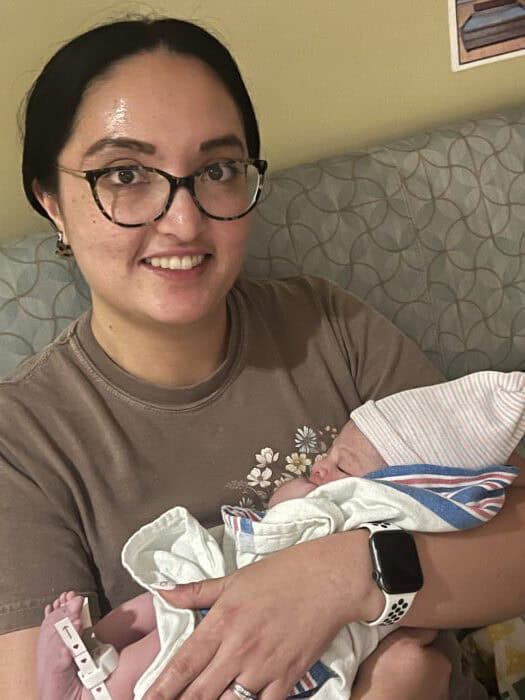
Charlotte is a Coast Guard wife, mother, and doula, and she has dedicated her work to supporting military families throughout their prenatal, labor, and postpartum journeys. After her own traumatic birth experience and a difficult postpartum season, Charlotte recognized the importance of having an advocate and supporter, especially when deployments and far-away duty stations leave new and expecting mothers on their own.
Desperate for Answers
Charlotte received her prenatal and postpartum care with civilian providers in Florida, and while she “thought my body would have known what to do…it’s not that simple.” She ended up with an emergency C-section because her heart rate was dropping, and her daughter was not tolerating Pitocin. She was separated from her daughter for 7 hours while she was taken to the NICU for additional care, and she sadly recalled that she “know[s] what it’s like to be left in an empty room alone.”
Her daughter ultimately had to stay in the NICU for four days, but Charlotte was frustrated by the minimal answers she received about her daughter’s condition from the medical team. She had to ask three times to speak with a doctor, and she felt that the answers she received from the nurses were surface-level. Similarly, she had to continuously ask for a lactation consultant. It was “a lot of advocating I didn’t expect to do freshly postpartum,” she said, and even with her husband present and her sister-in-law (who is a neonatologist) available to help, she felt herself struggling to find the answers she needed.
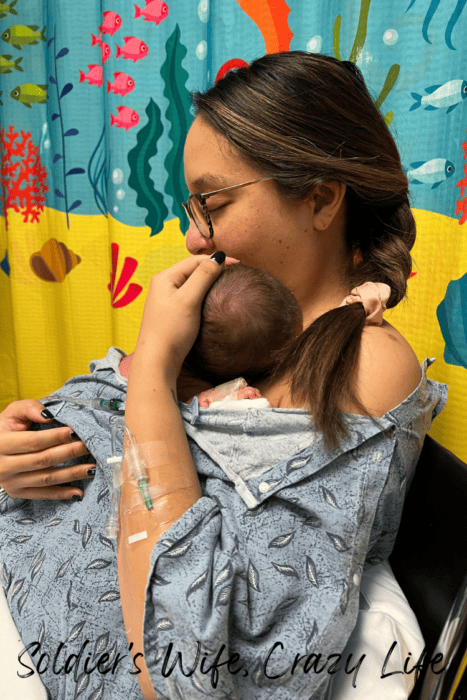
Overall, she felt overwhelmed by her birth experience, and her postpartum days were marked by loneliness, frustration, and deep sadness. She recalled her first night home from the hospital and how she awoke to find an empty bassinet. She freaked out because she forgot that her daughter was still in the NICU. To this day, Charlotte doesn’t have answers to many of her questions about her traumatic birth and recovery, and she’s gone through a lot of therapy to process and heal from the experience.
Feeling Alone and Finding a Lifeline
After her daughter was able to come home, Charlotte felt “crazy” and didn’t leave the house for six months. She found it hard to talk to people about what she was going through because of the unique struggles of military life. People tried to give her well-meaning advice, but Charlotte felt that many other moms “don’t get that experience…it’s not a normal job where your spouse can just take leave.”
Her husband had to go out to sea and split his paternity leave, and she recalled the difficulty of not having regular and easy contact with him. While she recognized it wasn’t her husband’s fault that he was gone during such a sensitive and critical time, she still felt upset, alone, and unsupported. While she had one friend come over to help, she felt that most people just wanted to see her baby rather than offer her the support and care she so desperately needed as a new mom.
Additionally, she struggled with feelings of shame. She told herself, “Other moms had babies in the NICU for longer,” and because she felt that she wasn’t taken seriously at the hospital, she felt even worse. “I don’t know how I made it out of that,” she recalled, and credits her virtual support groups and therapist as being her “lifeline” during these difficult transitional months.
A Desire to Give Back and Supporting Military Moms
Charlotte needed time to work on herself and heal, but she soon felt the need to give back. “Being a doula is my way to heal,” she says, and she is determined to help other women see that “birth can be beautiful even if it doesn’t go to plan.” She began doing virtual trainings in Florida when her daughter was a year old, and she completed her certification in births in Guam after their PCS.
Guam has been a challenging and rewarding duty station for her as a doula because of the lack of maternity care resources, the distance many women are from their families, and the difficulties that deployments pose. She says that “holding space for all the feelings and all the emotions is sometimes what they [moms] need,” and she works to tailor her support to each client’s needs. For example, she can accompany women in person to their prenatal appointments or can join on speakerphone to help them feel less alone.
Making specialist appointments with Tricare can be a difficult and daunting process, and she works to advocate for and support women as they navigate the healthcare system. She helps women to draft questions before their appointments and gives them the space to vent if things don’t go according to plan. Her goal is to “help moms feel empowered to speak up.” After seeing the red flags in her own care and not knowing how to speak up, she works to ensure that women feel safe.
She recently started a support group for new and expecting moms because she knows “how lonely it can be.” She said that being in a support group “really helped me to know I’m not crazy…knowing you’re not alone and have other moms you can lean on helps a lot because it can feel really isolating.” She also offers birth education classes because “the more you know, the more empowered you are.” She wants new moms to “feel like the choices they make are their own.”
More Changes Ahead
After only a year in Guam, Charlotte’s husband received an opportunity to work in Puerto Rico. While Charlotte was in the midst of establishing her doula services in Guam, she is looking forward to her next steps after their move. She is interested in becoming a midwife so she can take a more hands-on approach to maternal care.
Katie McDonald is a Navy wife, and she and her husband are currently stationed in Guam. After 5 years as an English teacher, Katie is currently working as a freelance writer and enjoys writing about books and travel. https://www.katiereads.com/
Last Updated on June 30, 2026 by Writer
Leave a Reply